
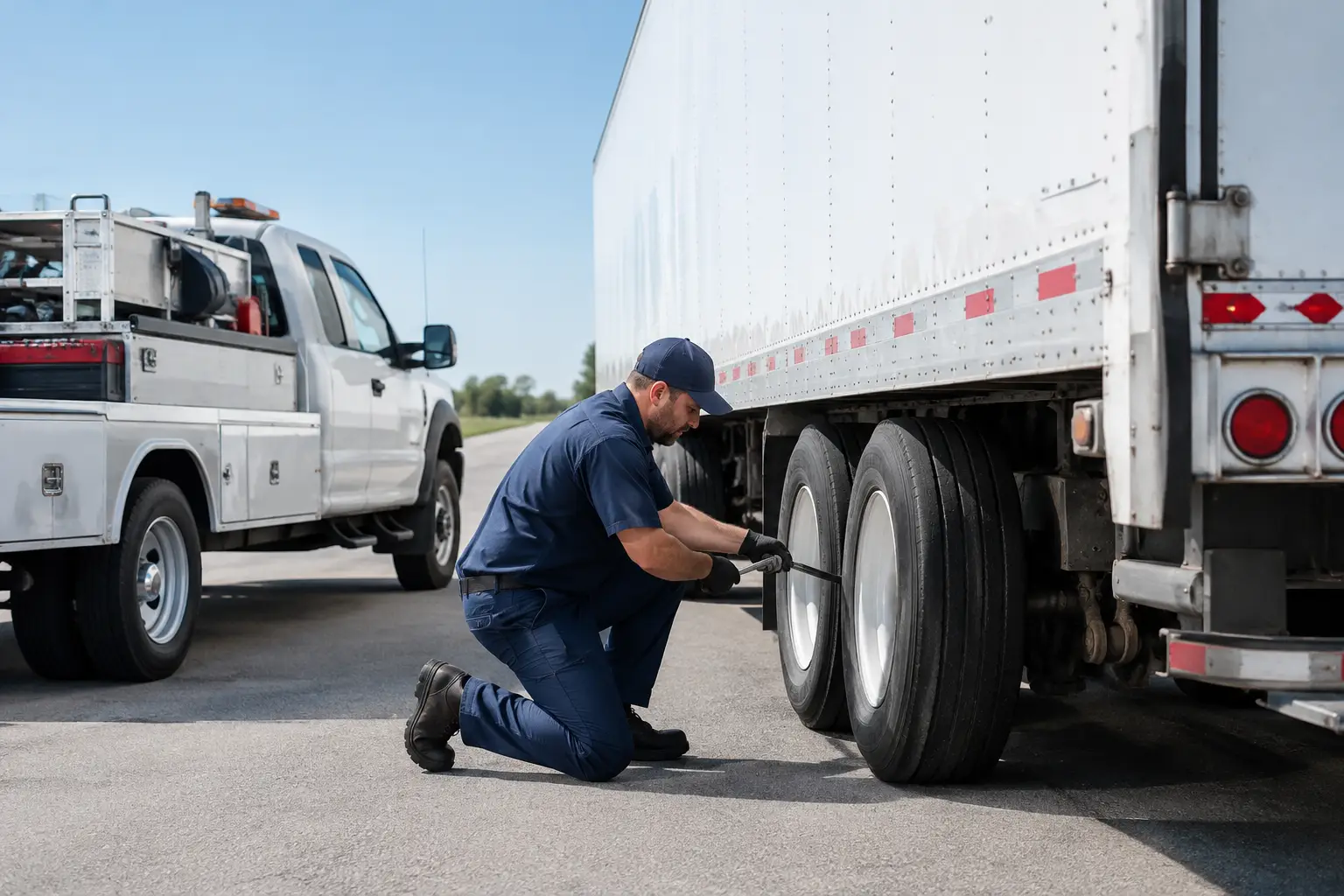
A trailer defect does not wait for a convenient delivery window. When freight is still on the deck or inside the box, the first question is usually the same: can technicians repair loaded trailers without delaying the load, creating a safety issue, or sending the unit to a shop?
Often, yes. A qualified mobile technician can handle many trailer repairs with cargo on board. But the repair has to be evaluated before work starts. Trailer condition, cargo weight and placement, the repair location, and the type of failure all determine whether the unit can be safely repaired where it sits.
For a driver, dispatcher, or fleet manager, the goal is not simply to get moving fast. The goal is to get moving safely, legally, and without turning a manageable repair into damaged freight, a roadside incident, or a more expensive breakdown.
What technicians can repair on loaded trailers
Many common trailer problems can be repaired while the trailer remains loaded, especially when the work does not require lifting the loaded trailer, removing a wheel under unsafe conditions, or accessing components blocked by cargo.
Mobile technicians regularly diagnose and repair electrical issues such as inoperative marker lights, turn signals, brake lights, damaged wiring, loose connectors, and corroded plugs. These repairs are often straightforward with a loaded trailer because they do not affect load support or cargo stability.
Air system problems may also be repairable on site. A technician can inspect for air leaks, replace damaged air lines or fittings, repair certain brake chamber or connection issues, and address problems at the tractor-trailer interface. The trailer must be properly secured before any brake or air-system work begins. If the brakes cannot hold the unit safely, the repair plan changes immediately.
Minor body and hardware repairs can frequently be completed with freight still aboard. That may include damaged door hardware, hinges, latches, mudflaps, conspicuity tape, landing gear handles, light brackets, and some securement-related components. A repair technician will still need to verify that the cargo has not shifted and that doors can be safely opened or closed.
Tire service depends on the situation. If a tire can be safely changed or repaired without compromising trailer stability, field service may keep the load in place. The loaded trailer must be parked on stable ground, supported correctly, and protected from traffic. A blowout that damages the wheel end, suspension, brake components, or trailer structure requires a more detailed inspection before the trailer is released.
When a loaded trailer should be unloaded first
There are times when keeping freight on the trailer is not the safe option. The added weight of cargo places stress on the frame, suspension, axles, tires, landing gear, and brake system. If the repair involves one of those load-bearing systems, unloading may be necessary before a technician can perform proper work.
A trailer with structural damage is a clear example. Cracked frame rails, damaged crossmembers, broken welds, compromised sidewalls, or impact damage around the suspension should not be treated as a quick roadside fix just because the shipment is time-sensitive. The cargo may need to be transferred before repairs or towing can happen safely.
Serious suspension and axle issues also require caution. A broken spring, shifted axle, damaged torque rod, failed suspension hanger, or wheel-end failure can make the trailer unstable under load. In these cases, a technician may be able to stabilize the equipment or help determine the next step, but a full repair may require unloading, load transfer, specialized recovery equipment, or a controlled move to a secure location.
Landing gear damage is another situation where cargo weight matters. If the trailer cannot support itself safely when disconnected, do not drop it and hope the landing gear holds. A mobile technician can assess the condition, but the trailer may need to remain connected to the tractor or supported with appropriate equipment until the load is removed or the landing gear is repaired.
Hazmat, temperature-controlled freight, livestock, oversized equipment, and high-value cargo bring additional requirements. The repair itself may be simple, but cargo rules, product sensitivity, or shipper procedures can control what happens next. For example, opening a trailer may not be acceptable without authorization, and a refrigerated unit with a temperature issue may need immediate cargo protection before mechanical repairs begin.
The repair location matters
A repair that is possible at a customer yard may not be safe on a narrow shoulder. Ground conditions, slope, weather, traffic exposure, available lighting, and room around the trailer affect every repair decision.
Soft ground can make jacking or supporting a loaded trailer unsafe. A steep grade can cause load shift concerns and increase the risk of trailer movement. On a busy roadway, a technician may need traffic protection and adequate work space before starting. Moving the trailer a short distance to a safer area may be the right call, even when the repair itself is minor.
What to tell the mobile technician before dispatch
Accurate information helps a mobile repair provider arrive prepared and reduce wasted time. You do not need a full mechanical diagnosis. A clear description of the symptoms and operating conditions is enough to help plan the response.
When calling for service, provide the trailer type, whether it is loaded or empty, the general cargo weight, and whether the load has shifted. Explain exactly what failed: a flat tire, locked brakes, air leak, lighting issue, damaged door, landing gear problem, suspension concern, or another defect. Let the technician know whether the tractor is connected and whether the trailer can move.
Share the trailer's location and the conditions around it. Mention if it is parked at a dock, on a shoulder, at a jobsite, on gravel, on a slope, or in an area with limited access. If the trailer carries hazardous materials, refrigerated goods, or freight that cannot be opened, say that immediately.
Photos can help when they are safe to take. A photo of the damaged tire, the leaking air line, the trailer underside, the wheel area, or the exterior damage may help a technician bring the right parts and tools. Do not crawl beneath a loaded trailer or enter traffic lanes to get a picture.
Protect the load while repairs are underway
The driver should keep the trailer secured, follow company procedures, and avoid attempting a temporary fix that creates a larger problem. Do not disconnect a loaded trailer with questionable landing gear. Do not release brakes or move a trailer with an obvious wheel-end, suspension, or structural defect. Do not open doors if cargo may have shifted against them.
If the trailer is in a hazardous roadside position, activate warning devices as required and contact emergency services when there is an immediate traffic, fire, hazmat, or injury risk. A mobile technician can repair equipment, but scene safety comes first.
Dispatch should also plan for the possibility that the load cannot continue on the original trailer. Having a backup tractor, an empty trailer, a yard location, or cargo-transfer resources available can prevent a repair decision from becoming a missed delivery. Not every repair requires that level of response, but having options matters when the problem involves structural support or cargo containment.
Can technicians repair loaded trailers without delaying freight?
Sometimes a loaded trailer can be repaired and returned to service in the same stop. Electrical faults, air leaks, minor tire issues, and damaged hardware are often resolved on site with little disruption once the technician has access and the trailer is stable.
Other times, the fastest safe solution is not a complete roadside repair. It may be a temporary stabilization, a controlled relocation, a load transfer, or a repair at a secure facility. That is not a failure of mobile service. It is the correct decision when the risk of working under load outweighs the time saved.
The best response is a technician who evaluates the whole operating picture, not just the broken part. MTG Truck Shops provides 24/7 mobile truck and trailer repair for equipment that cannot afford to wait at a shop. When a loaded trailer has a problem, give the technician the full picture early. A clear report helps determine whether the freight can stay put, the trailer can be repaired on site, and your operation can move forward safely.