
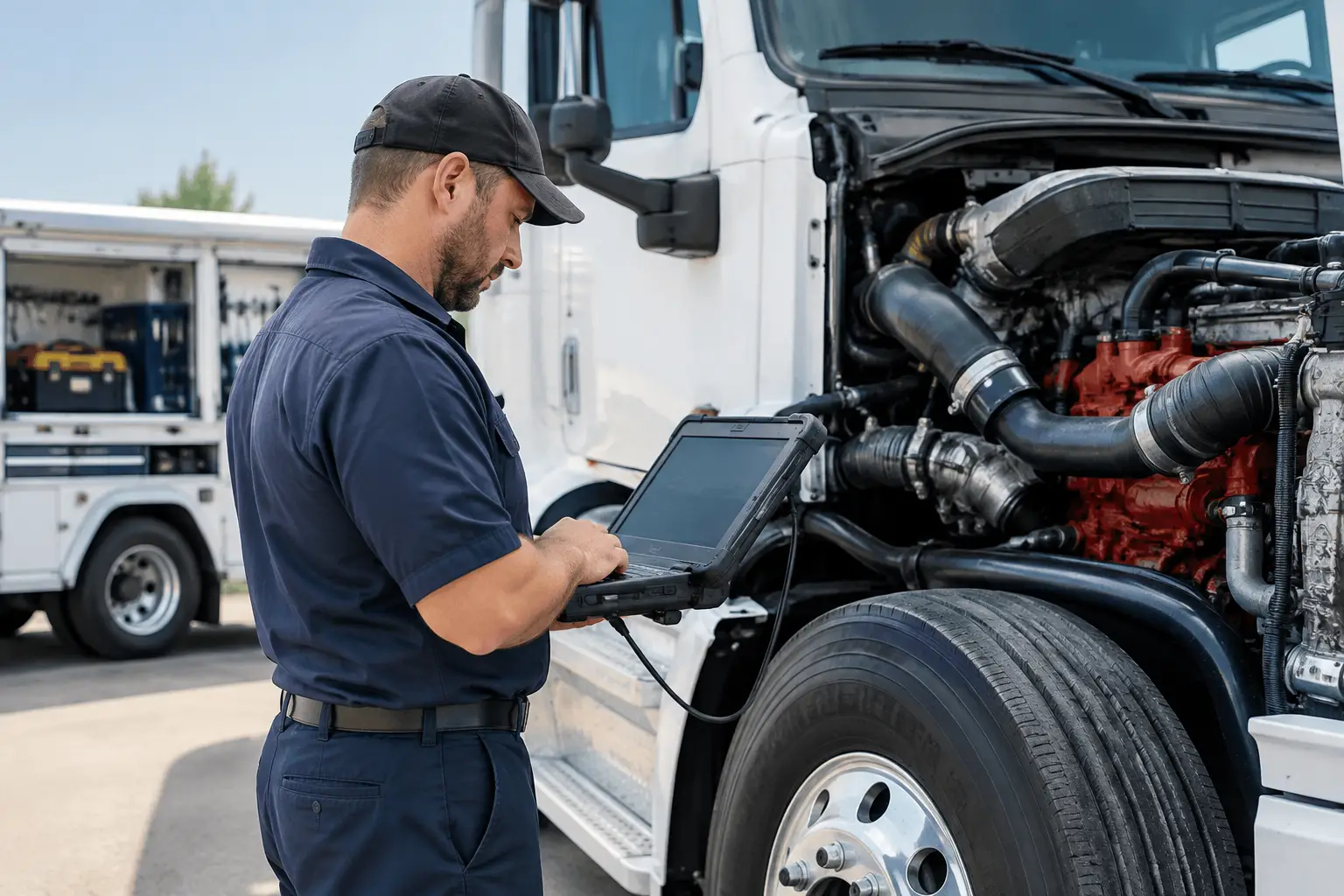
A warning light, hard start, loss of power, or active derate can stop a loaded truck just as effectively as a flat tire. Diesel diagnostics turns those symptoms into usable answers: what failed, what caused it, and whether the truck can safely move or needs repair where it sits. For commercial operators, that difference matters. Guessing at a repair wastes labor, parts, driving hours, and delivery time.
The right diagnosis is not simply plugging in a scan tool and reading a fault code. Modern diesel engines, emissions systems, air systems, electrical circuits, and aftertreatment components work together. A code points a technician toward a system. It does not always identify the failed part.
What Diesel Diagnostics Should Accomplish
The goal is to find the root cause quickly enough to make a sound repair decision. That may mean replacing a failed sensor, repairing damaged wiring, clearing a blocked fuel supply issue, correcting an air leak, or addressing an aftertreatment problem before the truck enters a more severe derate.
A useful diagnostic process starts with the driver's report. When did the issue start? Did it happen under load, after fueling, during regeneration, in cold weather, or after another repair? Is the engine losing power, consuming coolant, building abnormal exhaust temperatures, or showing multiple dashboard warnings? Those details can shorten diagnosis considerably.
A technician then confirms the complaint instead of relying only on the code history. That includes checking active and inactive faults, reviewing live engine data, inspecting connections and hoses, and testing the systems involved. If a truck reports low boost pressure, for example, the cause could be a turbocharger issue, split charge-air piping, a sticking actuator, an exhaust restriction, or a sensor reading incorrectly. Replacing the first part named by a fault code is not a diagnosis.
The Failures That Commonly Require Field Diagnosis
Commercial trucks accumulate problems where heat, vibration, weather, and heavy use meet. Some issues can wait for scheduled service. Others threaten a roadside shutdown, safety concern, or missed delivery.
Engine and fuel delivery concerns
Hard starting, extended cranking, rough idle, low power, or a no-start condition may come from contaminated fuel, restricted filters, air entering the fuel system, weak batteries, failed sensors, injector concerns, or high-pressure fuel system faults. The symptoms can overlap, which is why testing fuel pressure and electrical signals matters before repairs begin.
A truck that starts but falls flat under load also needs more than a quick visual check. The fault may only appear when the engine is working, hauling weight, or climbing a grade. Live data can show whether the engine is receiving the air and fuel it needs or entering a protection strategy.
Aftertreatment and emissions faults
DPF, DEF, SCR, and NOx sensor issues are frequent causes of reduced power and derate conditions. A dash message may tell the driver that regeneration is needed, but the reason behind the message can vary. Excessive soot loading can result from operating conditions, a failed temperature or pressure sensor, an exhaust leak, an engine performance problem, or a component failure within the aftertreatment system.
Forced regeneration is not a cure for every DPF-related code. If the underlying issue remains, the truck may return to derate soon after it leaves. Proper diesel diagnostics checks sensor readings, exhaust temperatures, pressure values, DEF quality when relevant, wiring condition, and the fault sequence before deciding whether a regeneration, repair, or further service is appropriate.
Electrical, charging, and starting problems
Many roadside failures are electrical. Corroded terminals, loose grounds, damaged harnesses, failing alternators, weak batteries, and blown fuses can produce faults that look like larger engine problems. Voltage irregularities can also affect sensors and control modules, creating several warnings at once.
Field testing should include battery condition, charging voltage, cable integrity, and voltage drop under load. A truck may show proper voltage while parked but fail when cranking or when electrical demand rises. Finding that distinction prevents a return call after an incomplete repair.
Air, brake, and trailer-related faults
Not every downtime event originates in the engine. Low air pressure, air leaks, brake chamber issues, ABS warnings, lighting failures, damaged trailer wiring, and connection problems can sideline equipment or make it unsafe to continue. On a tractor-trailer combination, the issue may be on the trailer even when the tractor shows the warning.
A mobile technician can inspect the full connection between truck and trailer at the breakdown location. That saves time compared with moving equipment to a shop only to discover a damaged gladhand, failed electrical connection, leaking line, or trailer-side component.
Why Fault Codes Need More Investigation
Fault codes are valuable, but they are clues, not verdicts. A code for a sensor circuit may mean the sensor itself failed. It could also indicate rubbed-through wiring, moisture in a connector, a poor ground, a blown fuse, or a control module issue. The same is true for pressure, temperature, and emissions codes.
The repair decision should come after the technician checks the circuit and compares the reported value to actual operating conditions. This is especially important on trucks that have recently had repairs, collision damage, battery replacement, or work performed near the affected harness. Those events can introduce problems that are easy to miss in a rushed inspection.
There is also a difference between a stored historical code and an active fault that is currently affecting operation. Clearing codes without addressing their cause may temporarily remove a warning, but it does not protect a driver from a repeat derate fifty miles down the road.
When Mobile Diagnostics Makes Sense
A disabled commercial truck does not always need a tow before the cause can be found. Mobile diagnostics is practical when the vehicle is parked safely at a customer site, truck stop, yard, roadside location, jobsite, or delivery point. A qualified technician can arrive with diagnostic equipment, electrical testing tools, common repair materials, and the ability to assess whether an on-site repair will get the unit moving.
It depends on the failure. A damaged engine, major internal component issue, severe wiring damage, or repair requiring specialized shop equipment may still require a shop visit. But diagnosis at the truck's location can establish that early, reducing wasted time and preventing unnecessary part replacement.
For a truck with an active warning, no-start condition, air leak, trailer electrical issue, or sudden power loss, waiting until normal business hours can turn a manageable repair into a missed load. MTG Truck Shops provides 24/7 mobile truck and trailer repair, bringing the diagnostic process to the equipment instead of requiring disabled units to reach a fixed repair location first.
What Drivers and Dispatchers Can Do Before Help Arrives
Clear information helps the repair move faster. Drivers should record warning messages exactly as they appear, note whether the truck can crank or run, and explain what changed before the failure. If it is safe, they can also provide the truck year, make, engine, unit number, location, and whether a trailer is attached.
Do not continue driving through a red engine warning, low oil pressure alert, overheating condition, serious air loss, or severe derate simply to reach a shop. Continuing can turn a repairable fault into equipment damage or create a road safety risk. Park safely, protect the scene, and report the symptoms.
Dispatchers can help by confirming access conditions. A technician needs to know if the truck is at a dock, on a shoulder, inside a secure yard, at a construction site, or blocked in by other equipment. Providing accurate location details and a working driver contact reduces delays before diagnosis even begins.
A Better Decision Than Parts Swapping
When freight is waiting, it is tempting to replace the most likely component and hope the truck returns to service. Sometimes that works. Often, it creates a second failure, additional expense, and more lost time. Testing first is usually faster than repeating a roadside repair.
Effective diesel diagnostics gives drivers, fleet managers, and dispatchers a practical next step: repair on site, move safely to a shop, arrange a specific part, or remove the unit from service before a minor fault becomes a major delay. The best outcome is not just clearing a code. It is putting dependable equipment back to work with a repair decision that holds up on the road.